
Get in touch: send your photos, videos, news & views by texting YOGAZ to 80360 or send email »
9:52am Tuesday 1st May 2007
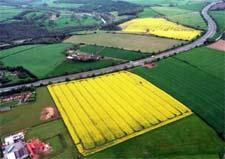
It is a crop of brilliant yellow that seems to be covering more of North Yorkshire's fields than usual this year, and one which has not always been welcomed by everyone.
But experts today swept aside the notion that oilseed rape can cause problems for hay fever and asthma sufferers - and explained why more people could be gropwing the crop in the area.
One factor could be farmers switching to rape from growing sugar beet, following the decision to shut the sugar beet factory in York later this year.
Rachael Gillbanks, spokeswoman for the National Farmers' Union North East, said: "Anecdotal evidence suggests that farmers in the area are growing more oil seed rape this year.
According to the British Medical Journal, there is no clear evidence that the crop has an adverse affect on human health, and it was suggested that the British have taken a dislike to it because of its flashy colour and intense smell."
She said other countries growing more rape than Britain were seemingly unconcerned about its prevalence. "It is also important to remember that rape flowers at the same time as many tree species, including the hawthorn, " she said.
Dr David Fair, of The Jorvik Medical Practice, in York, said he did not believe the crop brought on the symptoms of hay fever or asthma.
"My understanding is that oilseed rape doesn't release anything that brings on hay fever or asthma - any notion that it does is a complete myth, " he said.
"There has, however, as a result of the warm weather, been an increase in the levels of pollen from trees in the last week or so, which can bring on hay fever. It can also irritate asthma in those who suffer from it."
Dr Fair said there had been an increase in the number of patients with hay fever complaints in the last fortnight, but that he believed this to be a result of the tree pollen, and not the rape.
Mervyn Lewis, at York's Askham Bryan College, said said there were a number of factors encouraging the increase in the growth of rape in the area.
"One is that some farmers who previously grew sugar beet for the now closed York British Sugar Factory will now instead be growing rape. Another is the availability to farmers of energy contracts, under which growers are cultivating rape to be used as bio-diesel.
"The average price of rape has also been much stronger in the last 12 months - in 2006 it cost about £130 per tonne, but by 2007 this had risen to around £160."

Deek, Fife says...
5:37pm Fri 20 Jul 07
Add your comment
Register for a FREE Gazette & Herald account and you can have your say on today's news and sport by adding comments on articles we publish. The best comments may even get published in the paper.
Please register now or sign in below to continue.
Enter your postcode, town or place name
Looking for a new career? Find a job in Malton and all around North Yorkshire
Search Now »
Love and friendship - find your perfect match.
Search Now »
Find properties for sale and rent in and around Ryedale.
Search Now »
Find used vehicles for sale all over Ryedale and North Yorkshire.
Search Now »
Deek, Fife says...
5:37pm Fri 20 Jul 07
The BMJ article referred to by the experts was written by Hemmer in 1998. Hemmer’s assertions and opinions were based on the IEH Assessment A3 which was funded by the MRC in 1997 (the IEH Assessment was not in fact published in any of the learned journals). It is interesting to note that the IEH scientific committee did not undertake any research, they merely reviewed the published literature. In the Executive Summary of the IEH Assessment, the scientists’ advised that much more detailed research was required to fully elucidate the health problems associated with oilseed rape crops and listed the actual research priorities. This is extremely important, because many health commentators choose to omit these important facts.
Following the publication of Hemmer’s article in the BMJ, Dr. Parratt, a world authority on oilseed rape allergy syndrome who has published numerous papers on oilseed rape allergy syndrome, retorted by replying in a letter subsequently published in the BMJ a few weeks later.
If I may quote from D. Parratt’s response: -
We agree that true allergy to oilseed rape pollen is uncommon if defined as positive skin reactivity or a positive RAST test associated with appropriate symptoms. However, in our studies, we have shown that up to 40% of persons in rural communities suffer from symptoms such as eye irritation, runny nose, cough and wheeze. We consider there are two types of presentation: (1) true allergy which is uncommon and (2) an irritant effect on the respiratory tract and eyes which is more common and does not fit the classical definition of allergy. Hemmer fails to make this distinction which we believe is important.
We have sought EU support to compare the putative causes of oilseed rape allergy/irritancy in European countries and the UK. No funding was forthcoming. Until such studies are undertaken there can be no satisfactory resolution of the public concern that oilseed rape is a genuine cause of ill health.
In 1997, McSharry stated in his research paper published in Clinical and Experimental Allergy; oilseed rape allergy or sensitivity is a public health concern with economic and political interest. This subject still needs more work. Probably the best prospect will be a co-ordinated multi-disciplinary approach, with respiratory physicians, clinical scientists and plant biologists who have the confidence of the community and local authority in the areas studied.
In 2000, Galloway stated in his research paper published in Clinical and Experimental Allergy; In the light of all the above evidence, it would appear that although there is a definite reaction to the oilseed rape crop, not all of this is allergic and in the absence of atopy, individuals who exhibit symptoms and increased bronchial reactivity could be reacting to VOCs in the air. Whatever the reason, the effects of this crop cannot be easily accounted for by common immunological explanations.
From the information outlined above, it is clear that oilseed rape crops do indeed cause public health problems for those who live in close proximity to the rape fields. This is contrary to the views portrayed in the Gazette article.
oilseedrape.org.uk